Donec efficitur, ligula ut lacinia
viverra, lorem lacus.
Donec efficitur, ligula ut lacinia
viverra, lorem lacus.

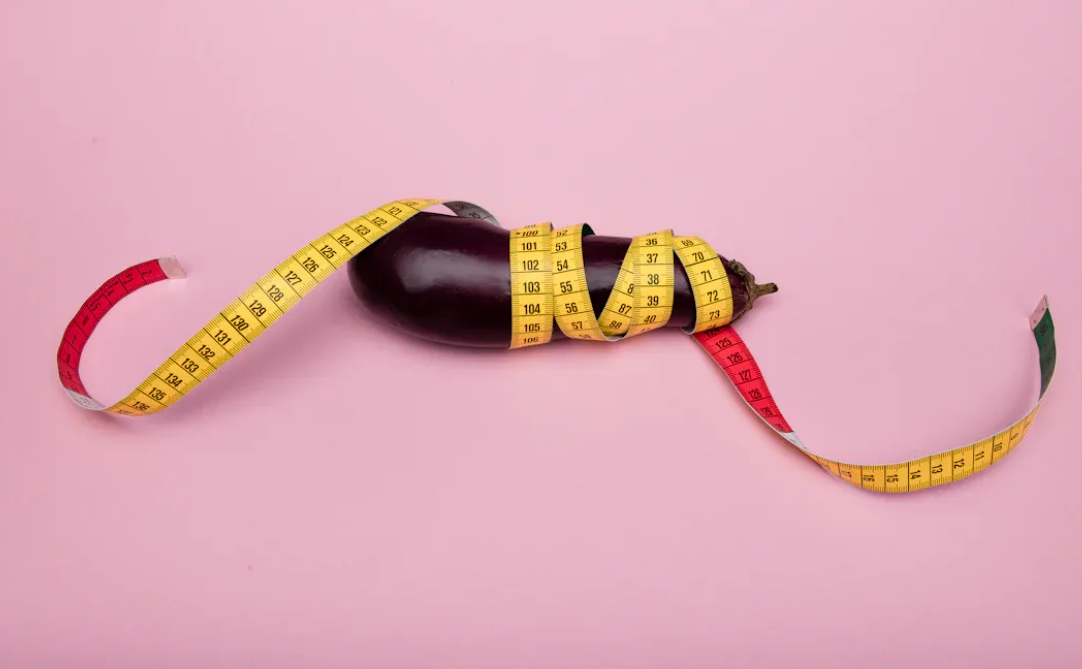
You can quickly determine if you lean toward the bigger side by measuring your penis and comparing your results to current 2025 benchmarks. The most recent studies list the averages as follows:
| Measurement Type | Length (inches) | Circumference (inches) |
|---|---|---|
| Flaccid | 3.63 | 3.58 |
| Erect | 5.45 | 4.69 |
| Stretched Flaccid | 5.06 | N/A |
Normal variation in size and shape includes differences in length, girth, and even curvature. Many factors—such as arousal level, time of day, and temperature—affect these measurements. You should know that only 35% of men report feeling satisfied with their size, which means anxiety about this topic is common.
You want a quick way to know if you lean toward the bigger side. Start by measuring your erect penis using a ruler or measuring tape. Place the ruler at the base, pressing gently against the pubic bone, and measure to the tip. Record the length in inches. Next, use a flexible measuring tape or a piece of string to measure the circumference at the thickest part. Compare your results to the latest 2025 averages.
Here is a practical example:
Case Study:
Alex measures his erect penis. The length is 6.1 inches, and the circumference is 4.8 inches. He checks the 2025 averages:
Measurement Type 2025 Average (inches) Erect Length 5.45 Erect Girth 4.69 Alex’s measurements are above both averages. He can confidently say he is on the bigger side.
If your measurements are above the averages in the table, you likely fall into the bigger side category. If your numbers are close to or below the averages, remember that normal variation is wide, and many factors affect size.
Using the most recent data gives you the most accurate comparison. Penis size averages have changed over the years. Outdated statistics may not reflect current trends. Consider these facts:
You should always use the latest benchmarks. This ensures your self-check reflects current standards. Relying on older data could lead to unnecessary worry or false confidence. The 2025 averages provide a reliable reference point for your assessment.
Tip:
Measure in a comfortable, private setting. Repeat the measurement a few times for consistency. Use the 2025 averages as your guide to see where you stand.
Accurate measurement helps you understand where you stand compared to the averages. You need to follow specific steps and use the right tools to get reliable results. Consistency and attention to detail matter for tracking changes over time.
You need a rigid ruler or a flexible measuring tape. A mirror can help you see the measurement clearly. Choose a private, comfortable space to avoid distractions.
You should measure both erect and flaccid states for a complete picture. Most benchmarks use erect measurements, but flaccid length can provide additional context.
Step-by-Step Guide for Measuring Length:
Tip:
Measure at the same time of day and in similar conditions to reduce variability.
Real-Life Measurement Case:
Case Example:
Jordan measures his erect penis. He stands upright, presses the ruler against the pubic bone, and reads 5.7 inches from base to tip. He repeats the process three times and gets similar results each time. Jordan records the average in his log.
Measurement Technique and Accuracy Table:
| Evidence | Description |
|---|---|
| Methodology Challenges | No universal standard for measurement technique, which affects accuracy. |
| External Factors | Temperature and anxiety can change the state of the penis and the results. |
| Observer Bias | Different techniques and perspectives can lead to varied reported sizes. |
You should measure girth at the thickest part of the shaft. Medical professionals recommend measuring at three points: base, mid-shaft, and just below the glans. Most studies use mid-shaft girth for comparison.
Many people pull the tape too tightly or leave it too loose. Inconsistent technique leads to unreliable results. Measuring only once or in different environments can also skew your data.
Step-by-Step Guide for Measuring Girth:
Note:
Repeat measurements over several days to track changes and ensure accuracy.
Common Mistakes Table:
| Mistake | Description |
|---|---|
| Pulling tape too tightly | Results in smaller girth measurement. |
| Leaving tape too loose | Results in larger girth measurement. |
| Measuring at different points | Leads to inconsistent results. |
| Not recording conditions | Makes it hard to compare measurements over time. |
Real-Life Measurement Case:
Case Example:
Sam uses a soft tape to measure his erect girth at the mid-shaft. He wraps the tape snugly and reads 4.6 inches. He repeats the measurement at the base (4.7 inches) and just below the glans (4.5 inches). Sam records all three numbers in his log.
You need to keep a log of your measurements. Record the date, time, and conditions for each session. This practice helps you track changes and spot trends.
Measurement Recording Table:
| Measurement Type | Method Description |
|---|---|
| Flaccid Length | Stand straight, relax, hold the penis along the shaft, measure from the base to the tip of the glans. |
| Erect Length | Achieve a full erection, measure from the base to the tip of the glans. |
| Flaccid Girth | Wrap tape around the thickest part of the shaft, ensuring it is snug but not tight. |
| Erect Girth | Wrap tape around the thickest part of the erect shaft. |
| Consistency | Measure at the same time of day and under the same conditions for accurate tracking. |
| Recording | Keep a log of measurements with date, time, and conditions to track progress over time. |
Callout:
Many men believe the average erect penis size is over 6 inches. Scientific studies show the average is closer to 5.1–5.5 inches. Accurate measurement helps you avoid misconceptions and gives you a realistic sense of where you stand on the bigger side.
Consistency and accuracy matter most. Use the same tools, measure in similar conditions, and record your results. This approach gives you reliable data and helps you understand your position compared to the averages.
You want to know how your measurements compare to the rest of the world. Researchers in 2025 reported updated global averages for penis size. These numbers reflect data collected from thousands of men across different continents. The table below shows the most recent averages for both length and girth:
| Measurement Type | Length (inches) | Length (cm) | Girth (inches) | Girth (cm) |
|---|---|---|---|---|
| Erect | 5.3 | 13.12 | 4.59 | 11.66 |
| Flaccid | 4.59 | 11.66 | 3.66 | 9.31 |
If your erect length measures above 5.3 inches or your girth exceeds 4.59 inches, you stand above the global average. For example, if you measure 5.8 inches in length and 4.7 inches in girth, you surpass the worldwide benchmarks. This comparison helps you understand your position in a global context.
Case Example:
You measure your erect penis and record 5.8 inches in length and 4.7 inches in girth. According to the table, you exceed both global averages. You can confidently say your size leans toward the bigger side compared to most men worldwide.
Penis size averages vary significantly by region. Some countries report much higher averages than others. The table below lists average penis sizes by country in centimeters:
| Region/Country | Average Penis Size (cm) |
|---|---|
| Ecuador | 17.61 |
| Cameroon | 16.67 |
| Bolivia | 16.51 |
| Sudan | 16.47 |
| Haiti | 16.01 |
| Netherlands | 15.87 |
| France | 15.74 |
| Canada | 15.71 |
| Germany | 14.52 |
| Iran | 14.55 |
| Democratic Republic of the Congo | 14.48 |
You notice that Ecuador leads with an average of 17.61 cm, while countries like Germany and Iran report averages closer to 14.5 cm. These differences reflect genetic, environmental, and lifestyle factors. The chart below visualizes these regional variations:
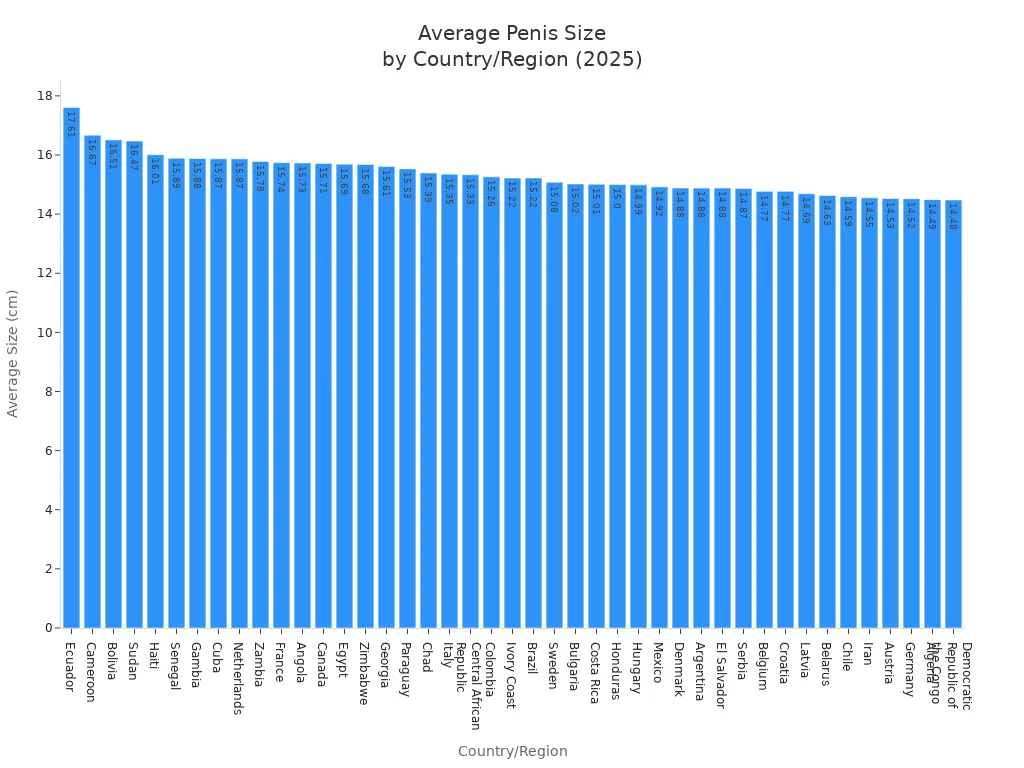
If you live in a country with a higher average, your measurement may align differently with local norms. For instance, a 15 cm erect length places you above the average in Germany but below the average in Ecuador.
You should consider the reliability of these benchmarks. Researchers collect data using standardized methods, but variations in measurement technique and sample size can affect results. Cultural perceptions also influence reporting. In some societies, men associate larger sizes with virility and success. For example, certain African cultures view a large penis as a symbol of fertility and power, which can impact self-esteem. In contrast, many Asian cultures do not emphasize size, and men may feel less pressure. Western media continues to shape global attitudes, creating new challenges for self-image.
Note:
Always use recent, peer-reviewed studies for your comparisons. Data from 2025 reflects current trends and provides the most accurate benchmarks for self-assessment.
You have measured your penis and recorded the numbers. Now, you want to know what those results mean. Start by comparing your measurements to the global averages for 2025. The average erect length falls between 13.12 and 13.59 cm (5.16 to 5.35 inches). The average erect girth is about 11.66 cm (4.59 inches). Most men—about 95%—fall within the erect size range of 9 to 16 cm.
When you interpret your results, consider both length and girth. Satisfaction often correlates more with girth than length. Preferences tend to cluster around average lengths combined with above-average girth. If your measurements exceed these averages, you likely lean toward the Bigger Side.
Tip:
Focus on both length and girth. Many men find that girth plays a larger role in satisfaction and confidence.
You may notice regional differences. For example, South America and Africa report higher averages (16 to 17 cm), while East Asia averages closer to 10 to 12 cm. Your position on the Bigger Side may shift depending on your local benchmarks.
You want to know what qualifies as the Bigger Side. If your erect length or girth is above the global average, you can consider yourself on the Bigger Side. However, most men fall within a broad range. Only a small percentage have measurements far above or below the average.
Here is a practical case study to help you interpret your results:
Case Study:
You measure your erect length at 15 cm (5.9 inches) and girth at 12.2 cm (4.8 inches). The global averages are 13.5 cm for length and 11.7 cm for girth. Your numbers place you above average in both categories. You fall into the Bigger Side group, which includes men whose measurements exceed the 50th percentile.
You should also consider psychological effects. Many men experience anxiety when comparing their size to published averages. About 63% of men with concerns say their worries began with childhood comparisons. Another 37% attribute their anxieties to erotic images seen during adolescence. None of the men studied had a micropenis, showing that anxiety often arises from perception rather than reality.
Percentiles help you understand where you stand compared to others. If you fall into a higher percentile, your measurements exceed those of most men. The table below shows a breakdown of percentiles for erect length:
| Percentile | Erect Length (cm) | Erect Length (inches) |
|---|---|---|
| 5th | 9.5 | 3.7 |
| 25th | 11.5 | 4.5 |
| 50th | 13.5 | 5.3 |
| 75th | 15.5 | 6.1 |
| 95th | 16.5 | 6.5 |
If your erect length measures 15.5 cm, you fall into the 75th percentile. This means your size is greater than 75% of men worldwide. If your measurement is 13.5 cm, you are at the median, or 50th percentile.
Note:
Percentiles provide a clear way to see if you are on the Bigger Side. Most men fall between the 25th and 75th percentiles. Only a small group exceeds the 95th percentile.
You can use percentiles for girth as well. If your girth is above 11.7 cm, you are above the median. If your girth reaches 12.5 cm, you approach the 75th percentile.
🧑⚕️ Practical Advice:
If you find yourself worrying about your size, remember that most men fall within the average range. Focus on health and confidence rather than comparison.
You may notice a curve in your penis when erect. Urologists consider a slight curve completely normal. Most men have some degree of curvature, which rarely affects sexual function or comfort. The typical range for normal curvature falls between 5 and 30 degrees. You might see the shaft bend slightly upward, downward, or to one side. This variation does not usually signal a health problem.
Tip:
If your penis curves but does not cause pain or interfere with sexual activity, you likely fall within the normal range.
Imagine you measure a 15-degree upward curve during an erection. You experience no pain and have no trouble with intercourse. This scenario represents a normal curvature. On the other hand, if you notice a sharp bend of 45 degrees that causes discomfort or difficulty during sex, you may need further evaluation.
You should pay attention if the curvature causes pain, distress, or problems with sexual function. Medical guidelines highlight that curvature may indicate a problem when it compromises your ability to have sex or affects your quality of life. Peyronie’s disease is the most common condition linked to abnormal curvature. Scar tissue forms inside the shaft, leading to a bend that often does not improve over time. You may notice pain during intercourse, difficulty with penetration, or even shortening of the penis.
During an erection, a pronounced bend can signal underlying scar tissue. If you experience pain, trouble with penetration, or a significant loss of length, you should seek medical advice. Doctors can assess the severity and recommend treatment options.
| Condition | Prevalence (%) | Typical Symptoms | Medical Threshold for Concern |
|---|---|---|---|
| Peyronie’s Disease | 0.4 – 7 | Pain, severe bend, shortening | Curve >30°, pain, sexual problems |
| Normal Curvature | N/A | No pain, mild bend | Curve <30°, no functional issues |
🧑⚕️ Alert:
If you notice a sudden change in curvature, pain, or difficulty with sexual activity, schedule a consultation with a urologist.
Curvature can influence how you perceive your size. Psychological studies show that men with pronounced curvature, especially those with Peyronie’s disease, often feel less confident about their size. The degree of curvature affects self-esteem more than changes in girth. You may feel that a curved penis appears shorter, even if measurements place you on the Bigger Side. This perception can impact your psychosocial well-being.
You should remember that most men with curvature fall within the normal range. Only a small percentage experience medical conditions requiring treatment. The prevalence of Peyronie’s disease ranges from 0.4% to 7% according to 2025 data. If you measure above average in length or girth, a mild curve does not change your status on the Bigger Side.
Note:
Curvature rarely affects actual size. Your measurements remain valid for comparison, as long as you measure along the shaft from base to tip.
Your body type can influence how you and others perceive penis size. Research shows a loose statistical relationship between penile length and body height. Taller individuals often appear to have larger penises, which can affect self-esteem and body image. Weight does not show a strong correlation with penile length, but abdominal fat may obscure part of the shaft, making the penis look shorter.
Tip:
If you feel concerned about your appearance, remember that perception does not always match reality. Accurate measurement gives you a true sense of your size.
Case Example:
You stand 6’2″ and measure your erect length at 5.5 inches. Friends may assume your size is above average due to your height, but your measurement aligns with global averages. This shows how body type can distort perception.
| Body Type | Perceived Size Impact | Actual Measurement Impact |
|---|---|---|
| Tall | Often seen as larger | May align with averages |
| Short | Often seen as smaller | May align with averages |
| Overweight | May appear shorter | Shaft may be obscured |
Erection quality plays a key role in accurate measurement and perception. Studies show that men with normal erectile function have an average fully stretched penile length of 12.9 cm. Men with erectile dysfunction (ED) average 11.2 cm. This difference is statistically significant, highlighting the impact of erection quality on perceived size. Girth measurements do not show a significant difference between these groups.
🧑⚕️ Practical Advice:
If you notice changes in erection quality, consider consulting a healthcare professional. Erection health affects both measurement and confidence.
Case Example:
You measure your penis during a strong erection and record 13 cm. On a day with weaker erection quality, you measure 11.5 cm. This variation demonstrates why consistent conditions matter for accurate self-assessment.
| Erection Status | Average Stretched Length (cm) | Average Girth (cm) |
|---|---|---|
| Normal Function | 12.9 | No significant change |
| Erectile Dysfunction | 11.2 | No significant change |
Many other factors shape your perception of penis size. Sociocultural influences play a major role. Exposure to pornography often sets unrealistic expectations, as actors typically display above-average sizes. Peer comparisons in locker rooms and teasing about appearance can distort your view of what is normal. These experiences may lead you to believe that your size falls short, even when measurements align with global averages.
You should recognize that these influences do not reflect reality. Scientific studies confirm that most men fall within the average range. If you focus on accurate measurement and reliable benchmarks, you can build a healthier self-image.
Note:
Comparing yourself to media portrayals or peer opinions rarely provides an accurate assessment. Trust scientific data and your own measurements for a realistic perspective.
You can take practical steps to build confidence about your penis size. Psychologists recommend several strategies that help men feel more secure and satisfied:
Self-acceptance plays a vital role in shaping your confidence. Many men tie their satisfaction with penis size to their overall self-worth. Improving self-acceptance can significantly enhance how you feel about yourself.
Learning how to accept your penis size is a game-changer. Not because it changes your body — but because it changes how you carry it. A man who walks into a room comfortable in his skin radiates power.
Practical Case:
Imagine you feel anxious after comparing yourself to online averages. You start practicing mindfulness and discuss your concerns with your partner. Over time, you notice less anxiety and greater satisfaction during intimacy. This approach helps you build lasting confidence.
You should consult a healthcare provider if you notice any of the following issues:
These symptoms may signal underlying medical conditions that require professional evaluation. Early intervention can prevent complications and improve outcomes.
Practical Case:
Suppose you notice a new, painful bend in your erection and a firm lump under the skin. You schedule an appointment with a urologist. The doctor diagnoses Peyronie’s disease and discusses treatment options. Prompt action helps you manage the condition and maintain sexual health.
Your overall health has a direct impact on penis function and sexual satisfaction. Medical research highlights several key connections:
| Health Condition | Impact on Penis Function |
|---|---|
| Heart Health | Erectile dysfunction (ED) can signal heart disease and blood flow issues. ED links to higher risk of heart attack, cardiac arrest, and stroke. |
| Diabetes | People with diabetes are three times more likely to report ED. ED often occurs earlier and is more severe in these patients. |
| Mental Health Issues | Depression, anxiety, and stress can lower sexual performance and reduce libido. |
You can support your sexual health by managing chronic conditions, staying active, and seeking help for mental health concerns. Regular exercise, a balanced diet, and stress management all contribute to better sexual function.
Tip: Prioritize your health. Addressing heart health, blood sugar, and mental well-being can improve both your confidence and your sexual satisfaction.
Practical Case:
You start a new exercise routine and make healthier food choices. Over several months, you notice improved energy, better erections, and increased confidence. Focusing on health benefits your entire life, not just your sexual well-being.
You can check if your penis leans toward the bigger side by following these steps:
Medical professionals emphasize that size and shape vary widely due to genetics and other factors. Myths about penis size often cause unnecessary worry. Focus on confidence, sexual competence, and mutual satisfaction. If you have concerns, seek advice from a healthcare provider.
🩺 Remember: Body positivity and health matter more than numbers.
You should measure once a month under similar conditions. This practice helps you notice any changes over time. Consistent measurement reduces errors caused by temperature, arousal, or stress.
Penis size remains stable after puberty. You may notice minor changes with aging due to reduced blood flow or hormonal shifts. Most men do not experience significant shrinkage until advanced age.
Losing abdominal fat can reveal more of the shaft, making your penis look longer. The actual size does not change, but visibility improves. Many men report increased confidence after weight loss.
A slight curve is normal. Most men have some degree of curvature, usually between 5 and 30 degrees. You should seek medical advice if you experience pain or difficulty during intercourse.
Focus on sexual health and confidence. Most men fall within the average range. You can discuss concerns with a healthcare provider. Satisfaction depends more on communication and intimacy than size.
Studies show that communication, technique, and emotional connection matter more than size. Most partners report satisfaction regardless of measurements. You should prioritize mutual pleasure and understanding.
No scientific evidence supports natural enlargement methods. Exercises, supplements, or devices rarely produce lasting results. You should avoid unproven treatments and consult a doctor for safe options.
You should consult a doctor if you notice pain, lumps, severe curvature, or sudden changes in size. Early evaluation helps address medical conditions and prevents complications.